
Last fall, several Envision the Choptank partners traveled to Lancaster, Pennsylvania to participate in a learning exchange with Lancaster Clean Water Partners (LCWP). LCWP pioneered the Lancaster Stream Delisting Strategy, a program that provided insights to Envision’s Breaking Barriers to Ag BMPs Workgroup as they developed the Producer-Led Program. After receiving funding to launch the Producer-Led Program last year, Envision partners were eager to speak to LCWP program staff and partner organizations directly about the strategy employed in Lancaster County, the capacity needed to ensure success, and lessons learned throughout their process.
Lancaster’s Stream Delisting Strategy works to remove stream segments from the Environmental Protection Agency’s list of impaired waterways by concentrating restoration efforts in watersheds at the catchment-scale. This data-driven strategy expands the impact of LCWP partner organizations by geographically focusing limited resources to ensure that a smaller amount of work will result in outsized water quality gains. LCWP partner organizations work in these catchment areas to get multiple, adjacent landowners to install conservation practices at the same time. They have demonstrated success through monitoring water quality indicators, such as bug and fish populations.
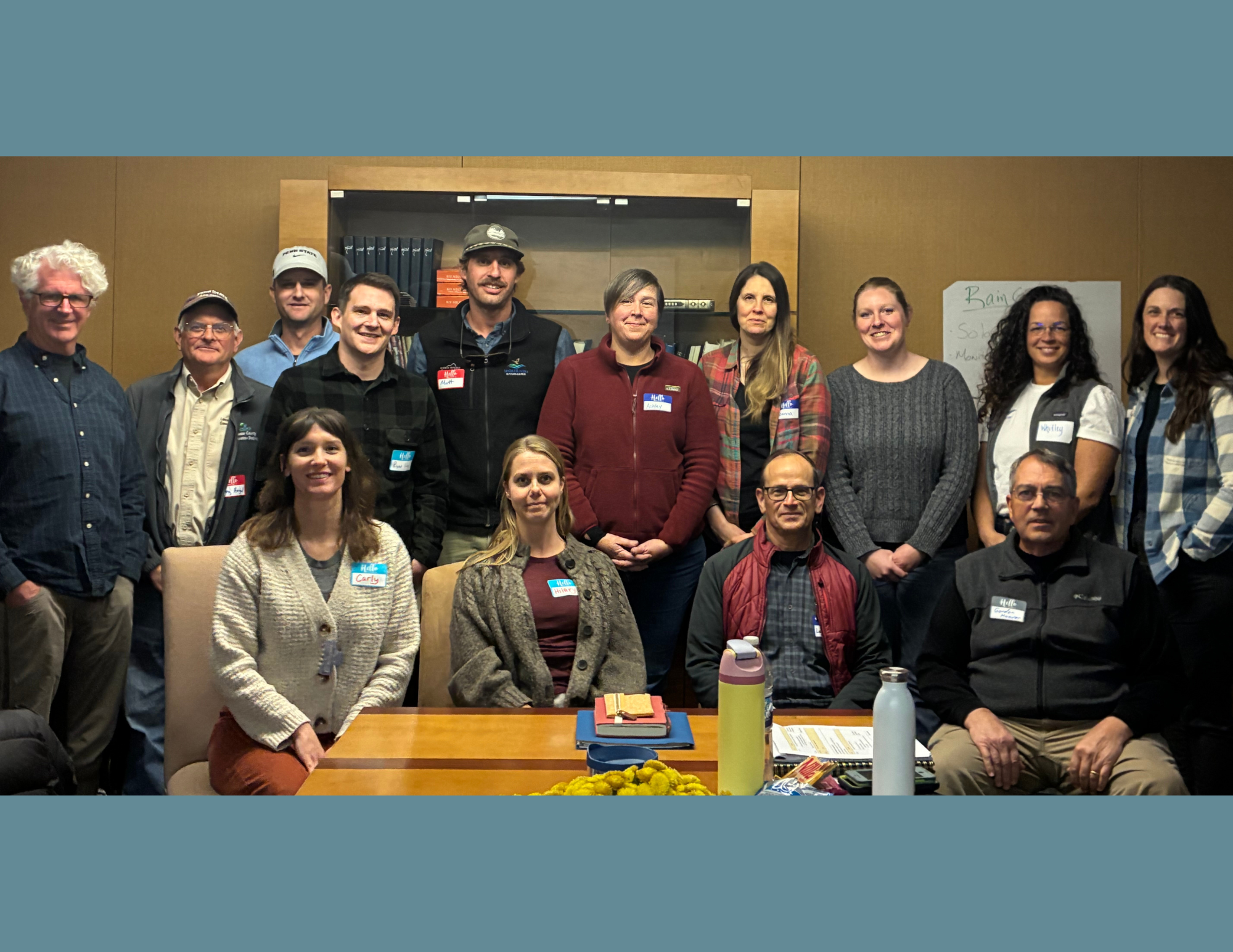
Envision the Choptank and Lancaster Clean Water Partners pose for a group photo at the Peer-to-Peer Learning Exchange in November 2025.
Supported by a Whole Watershed Program award from the State of Maryland and NFWF Small Watershed Grant, Envision’s Producer-Led Program focuses resources in small focal areas to accelerate water quality impacts, similarly to the Lancaster Delisting Strategy. The Producer-Led Program uses a farmer-led, holistic approach to support the implementation of multiple in-field and edge-of-field best management practices on individual farms and across multiple, adjacent farms in the same area. This is done through convening “Producer-Led Groups” of farmers and landowners living in the same area who meet regularly to discuss which best management practices and/or other solutions they want to implement together across their farms. Envision partners will co-create solutions with farmers to address both conditions in local waterways and agricultural productivity. By establishing and measuring performance of practices on many farms within the same watershed, improvements in local water quality will be shown, along with positive changes in habitat and soil health.
During the learning exchange, Envision and LCWP partners discussed the details of their programs. Above all, one of the greatest lessons learned from this exchange was the value of collaborating with trusted agricultural partners to inform project development, implementation, and outreach. LCWP also shared how their collaborative plays a role in connecting partner organizations with professional development opportunities related specifically to outreach on agricultural conservation, a role that Envision could potentially play in the future if the need emerges within the partnership.
In addition, the Chesapeake Conservancy, an LCWP partner organization, provided resources on how they identify areas to work in, employing both qualitative data (landowner willingness, partner organization observations) and quantitative data (high resolution land use data, drainage areas, buffer opportunity areas). The Conservancy also shared resources for tracking program success, progress toward goals, and monitoring metrics. They encouraged Envision to consider the on-the-ground implementation efficiency when identifying projects as well as realistic goals to keep project momentum strong throughout the process.
After spending two days with LCWP in Lancaster County, the Envision team traveled back home to the Choptank watershed with an abundance of new ideas to consider and feelings of inspiration and renewed confidence. Envision and LCWP are both participants in the Chesapeake Bay Funder’s Network and Chesapeake Bay Trust’s Regional Capacity Building Grant Program, a 5 year program that is working with 5 collaborative networks within the Chesapeake Bay watershed to provide evaluation and training services, create relationship-building opportunities across networks, and increase capacity to accomplish shared goals at the intersection of community and watershed health. As part of this learning exchange, LCWP backbone staff and partners plan to visit the Choptank watershed in 2026.